Mount of Olives panorama

Mount of Olives panorama
A panoramic view of the Mount of Olives

Monday, February 27, 2012

A Crusader Afternoon

Because we did not have a student field trip to plan for today, the faculty (with Nancy Jackson and Jen Harper) went on an outing to three nearby sites, two of which, Abu Ghosh and En Hemed, had Crusader-era connections.  The third, Qiryat Ye'arim, is primarily important as an Old Testament site, though it had a Byzantine church built on it and currently boasts a lovely little church run by the order of St. Joseph of the Apparition.

Abu Ghosh is an Israeli-Arab town about 6 miles west of Jerusalem.  Throughout the period of the British Mandate and even during the dark years of the 1948 War, the townspeople maintained good relations with the Zionists and, since, with the Israeli government.  This contrasts with most of the Arab villages along the Bab el-Wad, the steep valley (often a narrow gorge) that leads from the coast up to Jerusalem, many of whom actively fought the Israelis and worked to block supplies from reaching the Jewish section of Jerusalem.

Anyway, while it later took its name from the Arab clan that ruled it in the Ottoman period, Abu Ghosh was the site that the Crusaders earlier thought was biblical Emmaus, the place where the Risen Lord revealed himself to two disciples after walking with them 60 stadia (KJV, "furlongs"; see Luke 24:13-35).  The Byzantines, on the other hand, had earlier associated the site of Neapolis (modern Latrun, see our earlier blog post) with Emmaus and followed texts that read "160 stadia" to give them the farther distance.

Abu Gosh features one of the best preserved Crusader-era churches in the Holy Land, one that is still maintained and used by a French Benedictine order.  While the building itself is still quite intact, its once magnificent frescoes, clearly done by local Christian artists working in the Byzantine style, have largely flaked off.  Some of the surviving ones had the faces of all the angels and saints removed because of Muslim prohibitions on representative art.  But those that have survived are still quite impressive.

The Crusader-era church in Abu Ghosh, perhaps biblical Emmaus

The doors read, "If anyone thirsts, let him come to me and drink."


Some of the remaining frescoes


This fresco, the Dormition of the Virgin, had all of its faces removed by later Muslim iconoclasts

This shot is for some of my organ-playing pals
Surprisingly, however, none of the frescoes recount the story of the Road to Emmaus or the famous dinner there, where Jesus revealed his identity after breaking bread with the two disciples.  Nonetheless, sitting in the crypt, we had a sweet experience as Kent read the story from Luke 24, after which we sang hymn 157, "Thy Spirit, Lord, Has Stirred Our Souls."

Going down into the crypt


Where we sat to read from Luke 24 and to sing together
After that we drove to the height above and to the west of Abu Ghosh known as Qiryat Ye'arim.  This is where the Ark of the Covenant, after it was restored by the Philistines to Bet Shemesh, was brought by the Israelites and where it stayed for 20 years until David brought it to the Temple Mount in Jerusalem (see 1 Samuel 6:21-7:2; 2 Samuel 6). The Byzantines had built a church on the site, no doubt an ancient high place, to commemorate this, and in 1924 a French order called St. Joseph of the Apparition rebuilt the church as the Church of Notre Dame de l'Arche de l'Alliance (Our Lady of the Ark of the Covenant).  The "steeple" of the church is a fantastic sculpture of the Madonna and Child standing on the Ark of the Covenant, the idea being that they old container of God's covenants and the seat of his presence was replaced by Mary, the Mother of Christ.

Church of Notre Dame de l'Arche de l'Alliance (Our Lady of the Ark of the Covenant)
Signs in French and Latin recalling the site's association with both the Ark of the Covenant and Mary
Mosaic floor from the original Byzantine church

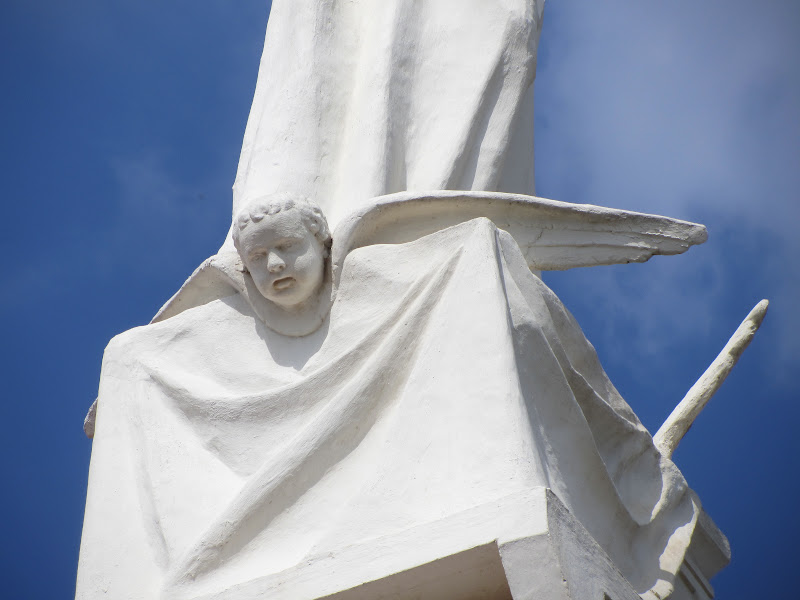
The interesting Madonna and Child on a tower at the east end of the church

The inside of Our Lady of the Ark of the Covenant
Mary and Child stand on top of the Ark of the Covenant

Whereas the original Ark of the Covenant faced inward, over the Mercy Seat, under the "new covenant" they face outward, as the gospel goes forth to all people
 

The grave of mother Josephine Rumbe, the foundress of the church

Our final stop was to En Hemed, an Israeli National Park built around a beautiful natural spring.  Here the Crusaders had also built either a farm complex (a manor, as it would have been called in feudal Europe) or perhaps a "retirement home for retired knights."  It was a great site where I would like to take the family. 

En Hemed

A sketch of how the Crusader building at En Hemed was used


The large Crusader-era "farm house" or knight's retirement center
We then went back to Abu Ghosh for a late lunch in a Lebanese restaurant.  It was a great day with good colleagues.

Wednesday, February 22, 2012

Separation Wall Discussion and Tour

This afternoon we had an Israeli lawyer and political activist, Danny Seidemann, come in and talk to our students about the history of Jerusalem since 1947, focusing on its contested state and fluxuating borders (see his interactive website).  The last part of his lecture focused on the so-called "Separation Barrier" that the Israelis have built between much of the West Bank and Israel proper, which in and around Jerusalem takes the form of a massive, concrete wall.  While the barrier causes considerable social and economic hardship on the Arab sector, many Israelis point to the drop in suicide bombings and other acts of terrorism since it was built.

In addition to last semester's blog post, below are pictures from today's tour of three sites: the Seven Arches Overlook, where Mr. Seidemann talked to us about the demographics of Jerusalem and pointed out the particular problem of the contested status of the Old City; a point in Bethphage where the Wall separates Palestinians in Jerusalem from Palestinians in adjoining Bethany (Al-Lazaria); and a West Bank overlook next to Hebrew University that let us see courses of the wall projecting into the West Bank as well as the Israeli settlement of Ma'ale Adumim.
Light blue is West Jerusalem before 1967. Green are Palestinian neighborhoods in East Jerusalem.  Dark blue represents Israeli neighborhoods and/or settlements beyond the recognized international boundary.
Both classes at the Seven Arches Overlook as the dilemma of the Old City is discussed
The Temple Mount and Old City: sacred and important to two nations and three religions

Danny Seidemann lecturing at Seven Arches

While most of the neighborhoods directly north, east, and south of the Old City are Palestinian, the Jewish cemetery on the western slopes of the Mount of Olives is an area that Israelis cannot part with.
Between neighborhood covering New Testament Bethany and Bethpage, the Separation Wall divides not Israeli Jews from Arabs but Palestinians within the Jerusalem municipal boundary and those without.


Danny Seidemann lecturing at the Wall


The following pictures were from an overlook that gives views of the West Bank.  From here we can see the Jordan River Valley and even the mountains and highlands of Jordan beyond.  But more immediately, we can see the Separation Wall blocking off Arab towns and villages from Israeli settlements on the other side.

My Old Testament class
Steve's Old Testament class

Ignoring the desperate over-the-cliff jokesters one can see Ma'ale Adumim beyond the bend of the backside of the Mount of Olives
This was the last "field trip" with our current classes. The Old Testament classes have their final exams a week from tomorrow.  After that I will take Steve Harper's class for New Testament and he will take mine.  The following pictures are just some "final pics" while I am with my first group.


With Megan Taylor and Jennifer Farrell
Tucker Davis is also my second counselor in the elders quorum presidency

Ashley Holt, Stuart Bevan, and Abe McKay

Crystal Myler and Crystal Redmond
These last pictures are of the Tsurim Valley just below our center.  I have included them because they illustrate the incredible beauty that the winter/wet season brings out of usually barren hillsides.  The valley is now a park, part of the "green belt" that includes the Qidron Valley.  While beautiful, these parks are in themselves political.  Israelis are not settling the areas, but they are indirectly controlling them through the parks systems, and some Palestinians complain that this is keeping them from building there.


Monday, February 20, 2012

Yad VaShem, the Holocaust Memorial (W12)

Today we had a sobering field trip to Yad VaShem, the official Israeli Holocaust memorial (click here for the official web site).  My camera battery gave out part way through, so in this instance many blog visitors will certainly want to see the blog post from last semester, especially its pictures from the Hall of Names at the end.


A poignant sign near the entrance has a line from Ezekiel 37:14, "you shall live again, and I will set you upon your own soil."


Before we went into the main part of the museum for a two-hour self-guided tour, Ophir Yardin, our Modern Near East (Israel) and Judaism adjunct faculty, gave our students an hour-plus orientation.  This was done outside, primarily on the "Avenue of the Righteous among the Nations," where carob trees commemorate Gentiles who risked their lives to save Jews, and in the plazas commemorating the Warsaw Ghetto Uprising and the dead of the concentrations camps. 

Ophir Yardin with our students


Walking down the Avenue of the Righteous among the Nations
 The main thrust of Ophir's orientation is not so much to provide a background to the Holocaust, which our students read about for their class, but to trace the development of changing Israeli attitudes towards the Holocaust and the issue of victim-hood.  For instance, when the memorial was established in 1953, the emphasis was on those who resisted the Nazis and died fighting as opposed to those who passively went to their deaths. 

Gathering in the Plaza Commemorating the Warsaw Ghetto Uprising

Two sculptures in the plaza depict two different responses to Nazi brutality and genocide . . .
Passive acceptance, going like sheep to the slaughter

and "heroic" resistance . . .

But both groups nonetheless perished.  The Hebrew inscription, bedemayik chai, means "in blood, life."

Critical events in Israel's history, such as the 1967 War and the Munich Olympics massacre of Israeli athletes further changed these attitudes.  Today a much broader view of heroism sees nobility and strength in the form of teachers who died with their students, for instance, rather than just those who actively fought and resisted.

The Hall of Remembrance, a "mausoleum" for those who died in the death camps, looms over the plaza

The mausoleum for those who had no graves.  See my blog post from last semester for pictures inside.

The Hebrew inscription is from Isaiah 56:5: "unto them I will give in mine house and within my walls a place and a name (Hebrew, yad vashem) better than sons and daughters: I will give them an everlasting name that shall not be cut off."  Originally a promise to eunuchs who were deprived of any posterity, this verse has been applied to those who otherwise died childless, and it certainly applies to the victims of the Holocaust or Shoa (catastrophe).
Coming out of the museum, which chronicles Jewish life in Eastern Europe that was virtually destroyed, the rise of the Nazis in Germany and Europe, and the human tragedy of the "Final Solution" one is almost overwhelmed.  However, the sight of the lovely slopes of Mount Herzl and views of West Jerusalem, lift one's spirits.  And one also exits by walking through the Avenue of the Righteous, a potent reminder that there was still good in the world at a time of such evil.

The beautiful slopes of Mount Herzl, particularly verdant and lovely in this "winter" season, provide a needed sense of tranquility after the heaviness of the museum exhibits.


Thursday, February 16, 2012

Passover Seder (Winter 2012)

Every semester, we hold a Passover seder to give our students the experience of celebrating this Jewish festival (see, for instance, the seder of Fall semester 2011).  This year Pesech, or Passover, does not start until sunset on April 18, but we held our center seder on February 16.

Traditional Passover plate
Passover, of course, is the festival that celebrates the Lord's miraculous delivery of the Children of Israel from slavery in Egypt and particularly how the angel of death "passed over" the first born of Israel whose doors were marked with the blood of the paschal lamb.  Christians, of course, apply this imagery to how the blood of the Lamb of God causes sin and death to pass over us.

Our Judaism and Modern Near East (Israel) teacher, Ophir Yardin, led this traditional service, which we held in the Oasis cafeteria.  It included, of course, a festive meal.

Here is the higlights video from tonight's event.  My camera included several clips from the final musical number, a humorous rap based on the traditional song "Who Knows One?"  The whole video of this appears at the end of this post.


Rachel joins some of the female students