Mount of Olives panorama

Mount of Olives panorama
A panoramic view of the Mount of Olives

Monday, August 29, 2011

Quick Errata

I have been asked a few questions about some previous posts, mainly, where are the places we went on our abortive walk Sunday afternoon, and why do we need to get back by dark?

The rule about "not being out after dark" applies to the Old City and East Jerusalem area generally.  This part of the city is simply not as well-patrolled as West Jerusalem, and the culture is markedly different.  So it is just prudent advice from our center's security to not walk alone or in small groups at night.  We can always get a cab or check out a car and leave from the upper entrance of the center, however, which takes us directly onto one of the main thoroughfares that leads to West Jerusalem.

Pictures from Yesterday, Northern Israel

Now that I am home and have been able to download my pictures, I can give you some visuals to go with yesterday's blog entry.

First, pics from the Hellenistic (and then Roman) site of Beth She'an:
One of the cities of the Decapolis, known then as Scythopolis, was a major "Greek" city in the region

Signs of the earthquake that eventually ended Beth She'an

Like all good Greek cities, Scythopolis had a great theater

And every stage needs an actor!

Tel Dan is the area in northernmost Israel where the tribe of Dan relocated in the Book of the Judges. It is the site of springs that serve as some of the headwaters of the Jordan river.

The water literally flows out of rocks, which provides interesting christological symbolism

What started slow, small, and shallow, becomes a rushing torrent, much like the stream of water from the altar of the temple in the visions of Ezekiel and Zechariah
At the division of Solomon's kingdom, Jeroboam of the northern kingdom of Israel built and altar in Dan and set up a calf here. This is the remains of the high place as later reconstructed by Ahab.
"From Dan to Beersheba." Dan marked the northern border of Israel, then and now. Here we are looking across the border to Lebanon.
Not far from Dan is the site of Banias, ancient Panias (a cave and spring dedicated to the Greek god Pan). Herod Philip established the capital of his tetrarchy here, calling it Caesarea Philippi.  Nearby Peter made his famous declaration that Jesus was the Christ (see Matt 16:16).

Caesarea was a Hellenized site with several temples, including one to Augustus Caesar, who portrayed himself as the son of a God (the deified Julius Caesar). Here or nearby Peter proclaimed the true Son of God.

Cave and niches of Greek and Hellenized deities.

Har Bental, a high mountain post at the extreme north end of Israel was the scene of terrible fighting in 1967 and 1973. Here today it provides an overlook into Syria.


The rather dangerous Syrian border has nonetheless been quiet for almost forty years.

Israeli trenches left over from the 67 and 73 wars.

We ended a rather fast day of touring yesterday at Ein Gev, a kibbutz where are students and the program "relocate" for almost two weeks each semester as we do much of our study of the New Testament.

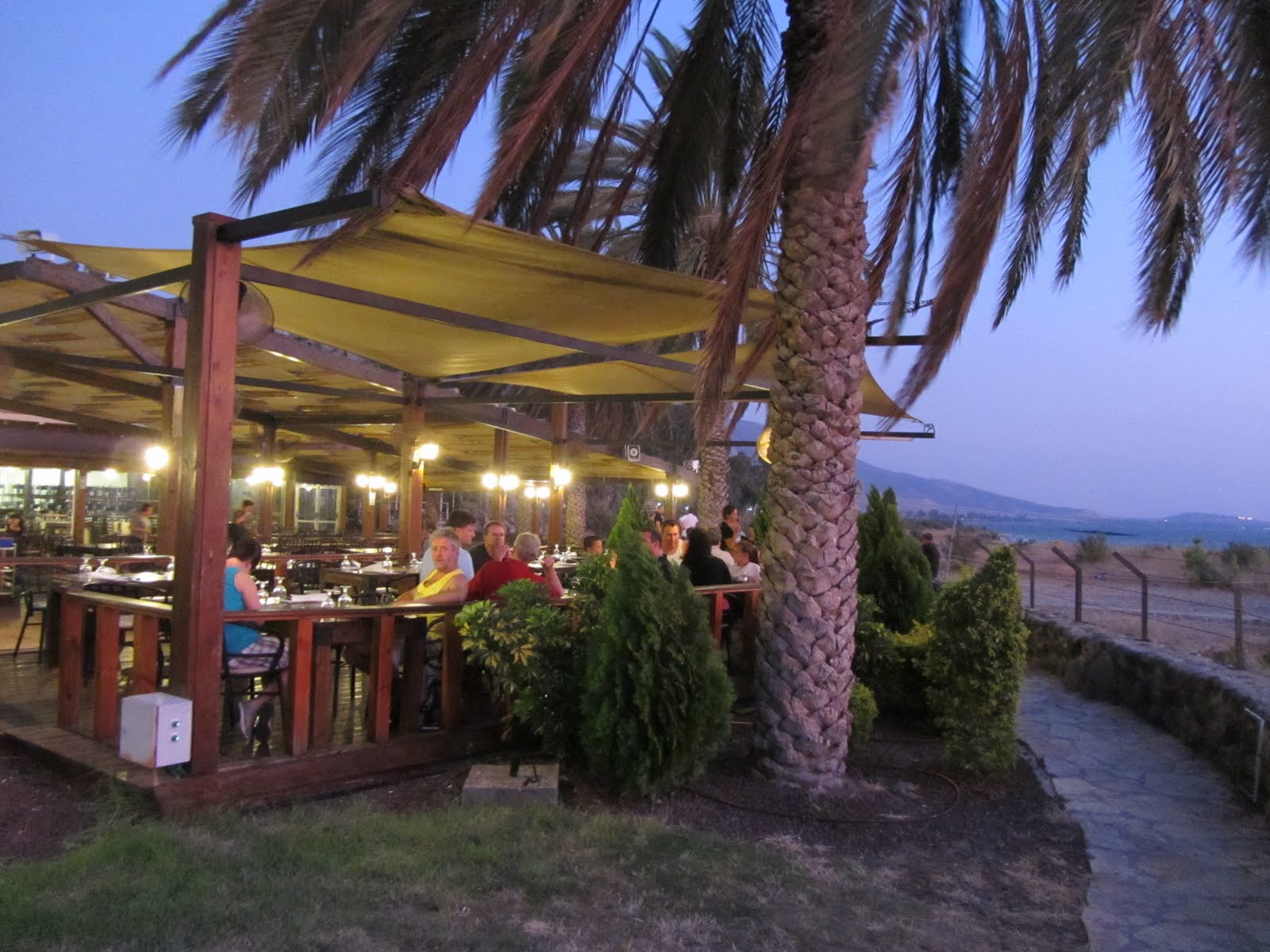
The sun sets over the Sea of Galilee


Ein Gev has a number of money raising enterprises associated with it, including a banana plantation, a boat company, a resort, and this restaurant.

For dinner I had fried "St. Peter's Fish," a type of sweet water fish native to the Sea of Galilee (though now grown on fish farms)

With the Jerusalem Center director, Eran Hayet, the outgoing academic associate director, Ray Huntington, and my colleague Steve Harper. In the right corner is a New Jersey Jewish man named Eric who visited with us and told us all about life on the kibbutz.


Sunday, August 28, 2011

Northern Israel

Sunday, August 28.  First, I must say that today's post is going to be a bit disappointing.  While I brought both my new digital work camera and high def video camera, I did not bring the jacks for either, so I do not have any images that I can post for today.  Sorry.  They will need to wait until tomorrow.

May I also say that today hardly felt like Sunday.  Having our free day on what is always going to be my gut sabbath is strange, but having it not feel like Sunday helped me not miss being in Choir so much.  All I have heard about today's Music and the Spoken Word broadcast was a Facebook message about their being an awful lot of roll-over images.

Early this morning my colleagues Steve Harper and Jared Ludlow and I joined the director, Eran Hayet, and the outgoing academic associate director, Ray Huntington, on a whirlwind tour of northern sites.  For most of our weekly field trips, which are a bus ride away from Jerusalem, the faculty can usually go to the sites a week in advance to do our pre-tour and get prepped to take the students there.  Galilee and northern Israel are rather different.  For almost two weeks, our program will actually relocated to a kibbutz on the eastern short of the Sea of Galilee called Ein Gev, which we will use as both our classroom for much of our NT gospels instruction and as a base for daily tours to sites in this area.  Since this area is 90 miles (or more) away from Jerusalem, we cannot get up here again and again for preparatory visits.  So today we whipped through an number of sites and tomorrow will finish up with the major Christian sites in Galilee.


Because I do not have any pictures available to upload, the best I can do is provide you a map of the territory that we covered today - it was a lot!


The points on the map may be too small to see on the blog, but our itinerary was as follows:

Left Jerusalem (A) at about 6:30.   We then drove along Israeli-controlled roads in Palestine through the West Bank down to Jericho and then up the Jordan River Valley.

Soon after we reentered Israel proper just south of the Sea of Galilee, we went a bit west to the site of Bet She'an (B)., which was known as Scythopolis in the Hellenistic and Roman periods.  That was because it was in those periods a Greek city of the Decapolis, later somewhat Romanized.  Its ruins boasted a great theater, two bathhouses, a colonnaded street, an agora or marketplace, and much else that made this erstwhile Classicist very happy.

Next we drove up to the Sea of Galilee, skirting its west coast and going through the large city of Tiberias.  We then went north to the site of Hazor (C), a great Canaanite city destroyed by Joshua and later refortified by Ahab of the northern kingdom of Israel.  It was later destroyed by the Assyrians and not rebuilt.

Our next few sites were in the extreme north of Israel, sandwiched between Lebanon and Syria (I am sure that trills my Mother!).  The first was Dan (D), where the tribe of Dan relocated during the time of the Judges and which served as a site of Jeroboam's alternative cult (calves in Dan and Bethel) after the division of the Solomonic kingdom.  The other was Panias (E), a water shrine known as Caesarea Philippi in the NT gospels, where Peter made his famous declaration that Jesus was the Christ, the Son of God (Matt 16:16).  We then visited a Crusader fortress known as Nimrod's Castle (F) before ascending another height that was the scene of terrible fighting in the 1967 and 1973 wars against Syria.  You'll get pictures of this border tomorrow.

Driving across the occupied (and annexed) Golan Heights, we at last came down to the Sea of Galilee till we got to our rooms in the kibbutz of Ein Gev (G) on the eastern shore of the lake.  We had planned to swim a bit, but we got here rather late and the waters were choppy (can you sing, "Master, the Tempest is Raging?").  Instead we had a wonderful fish supper on a wharf.  The type of fried fish we ate was actually called "St. Peter's Fish!"

At dinner we were joined by an Israeli named Eric (never got his last name) who was from New Jersey but "made aliyah" (formally immigrated as a Jew under the Law of Return) some 30 years ago.  He leads our students on a hike up to a Golan spring when they are here, and he had many interesting things to tell us about kibbutz life, social and economic philosophy, and history.  We sat there in that picturesque restaurant on a famous sea talking about interesting things until rather late in the night.

Tomorrow, JESUS sites!

Back at home in Jerusalem, Elaine and the children survived another day.  She and the other faculty wives made their first foray to the Arab money changer who cashes our American checks.  After a strange experience getting shekels, she went to a couple of stores, including an Israeli grocery store that was only somewhat better than the Arab one we had gone to Friday.  It was larger and a little bit more familiar, but crowded with pushy ladies with hordes of children.  Finally home to the center, she took the children around the center some more and let them play in the gym: Samuel was happy to play some basketball at last.  Back home, she decompressed by watching Toy Story 3 with them (and napping quite a bit).  I continue to feel a bit awkward that I am having these great historical experiences (and tomorrow they will be spiritual as well), while she must daily deal with the often challenging realities of setting up and managing a household here.  

Saturday, August 27, 2011

Our first Sabbath

For various reasons, the LDS Church here holds its worship services on Saturdays.  I think that this is largely for pragmatic reasons, since all of its members always have Saturday off, though I have mixed feelings about this.  While early Jewish Christians may well have continued to keep the Jewish Sabbath and it is unclear how soon the Church generally began to observe Sunday as its actual sabbath, the fact remains that from the the Resurrection onward, Christians observed the first day of the week as "The Lord's Day," when they met to commemorate the resurrection of Jesus and observe the Lord's Supper.  There is also a small but very old indigenous Christian community in Israel and Palestine that observes a Sunday Sabbath (including a group of local Latter-day Saints in Arab Bethlehem), and part of me wishes that we could exhibit more solidarity with them.

Those feelings on my part notwithstanding, Sabbath (sc. Saturday) services are well-established at the Jerusalem branch of the Church that meets each week in the BYU Jerusalem Center, as well as in the branches in Tel Aviv and in Tiberias in the Galilee.  And there IS something special about meeting on Saturday, that does give us a feeling of connection with Old Testament Israel AND contemporary Israel.

Early yesterday evening, we met the branch president, Mike Ohman, who asked Elaine to speak at this morning's services.  Earlier he had already asked my colleague Jared Ludlow and his wife Margaret to speak as well.  That did not get me off the hook: he happily asked me to sing a solo for sacrament meeting.  My standard line that I "do not like to sing in groups smaller than 300" (an oblique reference to my erstwhile Tabernacle Choir membership) made no impact.  I sang this morning anyway.

Given that Elaine continues to labor under a serious chest cold, jet lag, general feelings of being overwhelmed at needing to manage a household in this foreign land, and suffered from a last-minute wardrobe malfunction, she gave one of the more moving talks I have heard.  After briefly introducing our family, she used as her text Isaiah 53:3-5, testifying of how Jesus had surely borne her griefs and carried her sorrows, and she ended with a reading and testimony of Moroni 7:41-48, talking powerfully about the need for hope in Christ, the pure love of Christ, and being filled with the pure love of Christ.  I am married to one of the most wonderful women I know.

The Jerusalem Center auditorium is an amazing place to have church.  Surrounded by gardens on two sides, the front windows look out over the old city.  At the beginning of his talk, Jared mentioned that last night he had talked to his parents, who have served at the Jerusalem Center several times.  His mother told him that it really did not matter how well he spoke, because everyone would be looking out the windows anyway! To the southeast is a view of the Temple Mount, but throughout the meeting my attention was drawn straight ahead, to the silver-gray domes of the Church of the Holy Sepulchre, the likely place of the crucifixion and resurrection of Jesus.  Though not really visible from where we sat, somewhat to the north of that site across from the Damascus Gate is the Garden Tomb, which many Latter-day Saints and some Protestants hold as the site of those sacred events.

I sang the hymn "God of Our Fathers, We Come Unto Thee."  I thought that would be appropriate with the Old City and the Temple Mount behind me.  I also was asked to be the chorister for the meeting, which made me smile.  Prior to my call to the Choir, I had never held a music calling.  I had always been entangled in priesthood administrative type roles, but it looks like I am now pegged for life as the musical guy.  Only Elaine knew me well enough to know how hard both the singing and conducting were for me.  I felt the spirit in both, but my release from the Tabernacle Choir has left an aching void in my life which my modest musical efforts today did little to fill.

The Jerusalem Center auditorium serves as our chapel for Sabbath services. For meetings, the curtains are opened, revealing a magnificent view of the Old City.

Samuel and I on the rostrum after our block of meetings.

The beautiful Jerusalem Center organ.  Andy and Rick, eat your hearts out!  Rick will actually be here in early January to play at a concert celebrating the twenty-fifth anniversary of this wonderful instrument.

On either side of the chapel are beautiful gardens.


There were naps all around when we got back to our apartment.  While this is a rather typical Sabbath afternoon activity, it was rather ill-advised, because it did not help us any in our adjustment to the new time zone.  Then we had dinner: roast chicken, rice, and peas.  Close to a Sunday dinner at least.  There is even some cherry jello waiting for us later tonight, one of the valuable packages that Elaine sneaked into her luggage for occasions like this.

About 5:30 I took my family on our first walk into, or near, to the Old City.  We left the Center's lower gates and made the walk to Gethsemane, which was longer than I remembered.  I guess that in the past I have been myself or with other guys, and I did not take into account a still sick wife and little boy.  We had some good views of the Temple Mount, the Jewish cemeteries on the slopes of the Mount of Olives, and at last the Catholic and Orthodox traditional sites of the Garden of Gethsemane.

Looking up at the Temple Mount. A little of the gold Dome of the Rock is visible right of center, and the Golden Gate is featured right of center.

Looking across the Mount of Olives at the Church of the Agony (also known as the Church of All Nations). This Roman Catholic Church has a garden next to it with some old olive trees, which is associated with the Garden of Gethsemane.

Rachel and Elaine with the Golden Gate behind them, through which the Final Judge is supposed to enter the Temple Mount.

The southeastern corner of the Temple Mount is frequently associated with the Pinnacle of the Temple from the temptations of Christ.

The facade of the Church of All Nations.

The Golden Gate

A view of one of the Gardens associated with Gethsemane

This cat in Gethsemane caught my attention

The Russian Orthodox Church of Mary Magdalene

Jewish cemeteries on the Mount of Olives.  Burials began in biblical times and continued in the post biblical period, encouraged by a tradition that maintained that the resurrection will begin here.
Do not think that the wonderful sites pictured above meant that our first walk along the Mount of Olives was without its challenges.  We started rather late, and we need to be out of Jerusalem by dark each night.  But neither Elaine nor Samuel could (or in his case, would) walk very fast.  And before we even got to Gethsemane, Samuel decided that he did not want to do this and wanted to go back to the apartment.  It was all I could do to contain my disappointment, because these sites and what they represent are so important to me, and I want them to mean as much to my family.  A nice Arab man at the Greek Orthodox tomb of the Virgin saw me trying to console, cajole, and encourage my son and came over and gave him a piece of candy.  He then pointed to me and said, "Good Papa!"

A sullen Samuel in front of the Tomb of the Virgin, which includes a cave that the Orthodox hold as the site of Gethsemane. Elaine here is mimicking our boy's truculence.

A piggy back ride all the way back up Mt. Scopus got Samuel back into a good mood.
Darkness was falling and we needed to hurry, but the entire walk back up to the Center on Mt. Scopus was uphill.  So I ended up carrying my really big boy much of the way.  Ah, the things family memories are made of.  We now know that we will need to plan these outings differently, taking Samuel on only the shorter ones and checking a car out to drive rather than take long walks.

Along the way the call for evening prayer went out, and since it is still Ramadan, cannons boomed, letting our Muslim neighbors know that they could break their fasts.  It was neat to see many of them sitting on their roofs under Ramadan lights enjoying their festive meals.

In the middle of this picture our neighbors can be seen having their break-the-fast evening meal as part of their Ramadan celebration

The Dome of the Rock from the lower gate of the Jerusalem Center.


Friday, August 26, 2011

First Full Day

I will not say that Friday, August 26, was a particularly great day. In fact, it varied from tedious to one characterized by shell shock and eventual serenity.  This day was tougher than expected for my family.  The kids were marooned in our apartment as Elaine and I attended never-ending meetings. Grocery shopping is difficult and expensive.  But the city is still holy.

(And, BTW, do not fear that I am going to bug you with posts EVERY day. I am sure things will slow down after we get settled and things are not so new)

Tedious, you wonder, in Jerusalem? Yes. There were some necessary orientation and administrative meetings that ended up occupying much of the day, and though I do not know whether wives needed to be at all of them, Elaine slogged through hours in the morning and another hour or two in the afternoon, even though her chest cold is getting concerningly worse.

Shell-shock? Well, while that characterizes much of this first overwhelming twenty-four hours (much more so for Elaine and the children, who have never been here, than for me), perhaps I should also say "sticker shock."  After our meetings, our trainers, Ray and Sandy Huntington took us to do some initial grocery shopping.  This was complicated.  The Jewish Sabbath was approaching, and many Arab stores had been closed for Friday prayers.  And because of Ramadan, our usual money changers were not available. So the Huntingtons took us to one store, Jaffar's, that was both open and would take debit cards.

One week's of groceries, not all the items we wanted or exactly what we thought we were getting, cost 738.40 NIS (New Israeli Sheckels) . . . that is US$203.89!  A trip across the street to a butcher's shop for 4 kg of ground beef (which was ground right in front of us) and a single chicken cost US$37.28.

Elaine was discouraged, and frankly, so was I. But I was quickly able to put it in perspective by realizing that we had done nothing "fun" or "interesting" today . . . no historical or spiritual sites to temper all the differences that our lives here pose.

So later after we had put together a fairly familiar spaghetti dinner, Rachel and I went out and walked on the balconies of the center to look at Jerusalem again at night. Because it is still Ramadan, the Muslim holy month, many homes and streets in East Jerusalem are brightly festooned with lights, which looks almost like Christmas to our eyes.  The streets in the neighborhood all around us, clearly visible from the center's many balconies, were filled with happy, celebrating people.  Looking across to the Dome of the Rock, I thought of what that sacred place represented to Jews, Muslims . . . and Latter-day Saints.  Turning around, the beauty of the lit white walls of our center struck me.  The "Mormon University," as people here call it, is a landmark of its own, signaling our presence and interest in Holy City.

Earlier this evening church bells had been ringing, and a feeling of serenity---we call it the spirit in our tradition---enfolded me.  Just then the calls of the muezzins from dozens of mosques began to fill the air, conjuring up the reality of the Middle East where we now live.  In quiet homes elsewhere in the city, our Jewish friends were celebrating Shabbat with their families.  And we are part of all this.
Some Ramadan lights strung along a street are visible here.  The Dome of the Rock is there, though hard to make out.  I am not a good night photographer.

Rachel of Jerusalem.

It's a good enough shot for Dad, too.  You can see the Dome a bit better here.

The BYU Jerusalem Center for Near Eastern Studies really is a beautiful site all on its own.

Looking up at the center from the lower gate.


Rach is starting to feel at home here.

Evening panorama of Jerusalem during Ramadan

After a long (and somewhat frustrating) day, Rachel and I took a break to walk around the center and enjoy the lights of Jerusalem.  This video clip catches some of the sights, and sounds, of this city that is holy to so many.

Yesterday's Samuel Story

Yesterday, while driving from Tel Aviv to Jerusalem, Samuel made a sweetly innocent and heart-warming comment: "This is Israel.  This is where Jesus lives.  When do we get to see Jesus?" Scroll down to the bottom of Samuel's Page (August 26) for this story.