Negev Field Trip (10/3/11): Today we took the students to the Negeb or Negev region of Israel. Originally negev meant "dry land," but it has come to mean "the south." This was the region where Abraham, Isaac, and Jacob roamed in Genesis. Some of their nomadic lifestyle is still captured in the lives of the Arab Bedouin tribes that not live here. Before we go further, watch the following highlights video to get a taste of where we were and what we did:
Driving due west from Jerusalem (E on the map below), we skirted around the southern part of the Palestinian territories, the part the Israelis still call "Judea," to come first to the Bedouin town of Lakiya (B).
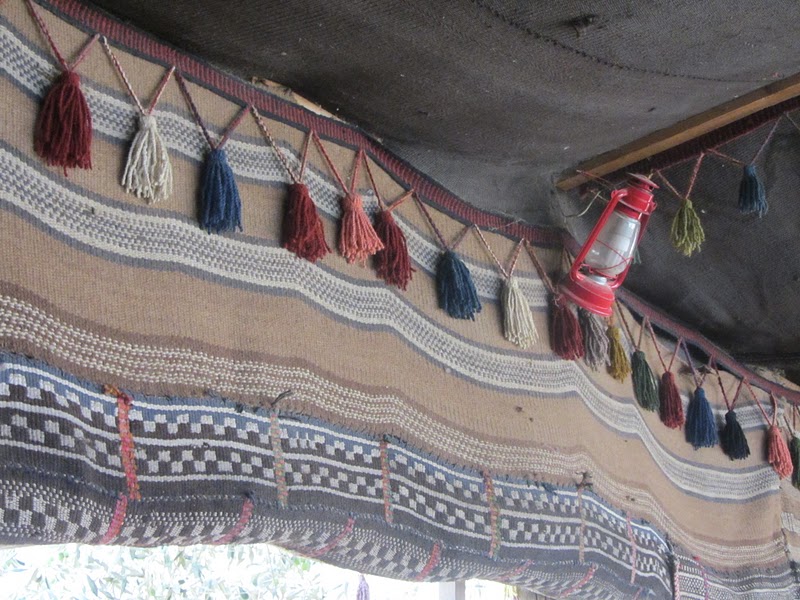
Here we visited the Sidreh Foundation, an organization that seeks to increase the literacy and economic status of Bedouin women by helping them develop and market their traditional handicrafts. Sitting under a traditional tent of spun goat hair, we listened to the matriarch of the organization, one of the first Bedouin women to get an education and learn to drive. After hearing her life's story, she demonstrated some of her people's crafts to us.
Lakiya is a Bedouin town, an Israeli-recognized community where they people have largely given up their nomadic ways of life. We then drove farther, seemingly into the middle of nowhere, to a Bedouin encampment where they were still living their more traditional nomadic lifestyle.
Elaine came with me on today's field trip. I loved having her company, and she regaled the students with stories of our courtship on the bus (they had already heard "my" side of these events while we were in Turkey).
The sheiks' area, where the men meet to make tea and talk
We thought that this was a sheepfold or a pen for animals, but the mud-walled structure turned out to be part of a winter home for Bedouins themselves.
Details of the next two sites we visited, Tel Arad and Tel Sheva, have already been posted as the Beersheba and Arad Pre-Trip. Go there for more pictures, including of the Israelite temple or sanctuary at Arad (C on the map above).
After Dr. Skinner had talked to the students about the site, I talked about the seeming injunction in Deuteronomy against worship outside of Jerusalem, and we discussed how this may have arisen largely from the later reforms of Josiah and Hezekiah. Standing in front of the Holy of Holies, we had a chance to talk about temple worship, past and present, which led us to sing "We Love Thy House O God."
Two standing stones in the devir or Holy of Holies of the Arad sanctuary
We then went to Be'er Sheva (D), more commonly known as Beersheba in the KJV Bible. This southernmost Israelite settlement was often used to demarcate the frontiers of biblical Israel in the geographic formula "from Dan to Beersheba." All the patriarchs (and matriarchs) pitched their tents here or near here. We ready from Genesis 21, 26, 28, and 46 in connection with the activities of Abraham, Isaac, and Jacob here. I also read the beginning of a 1973 article by A. Theodore Tuttle called "Altar, Tent, Well," which quite movingly drew lessons from the life of Isaac. Not as famous as Abraham or Jacob, Isaac built an altar, pitched his tent, and dug a well at Beersheba, showing through simply faithfulness and hard work how we can all worship, take care of our families, and work. Talking about the promises made to the patriarch led us to sing "Faith of Our Fathers."
Teaching about the patriarchs at Be'er Sheva
Elaine with some of the female students at Be'er Sheva.
Descending into the water works and cisterns
A few or our students with the reconstructed "horned altar" at Be'er Sheva
As I noted, more (and better) pictures of Arad and Be'er Sheva can be seen at an earlier post, Beersheba and Arad Pre-Trip. After a REALLY long day, we returned to Jerusalem (E).
Samuel loves the beach. Scroll to the bottom of Samuel's Page to see the day trip he and his family took to Tel Aviv so they could enjoy another beach outing. The entry includes a video montage and more pictures.
I will have more on these sites after we take the students to them, but for our faculty pre-trip, I was able to take my daughter, Rachel. It was fun to familiarize her with basic archaeology and to show her some landscape she has not seen yet.
Jared Ludlow's son Joseph also came. He and Rachel, along with two of the Harper teenagers, are taking seminary together, where they are studying the Old Testament. It was interesting for them to see the site where Abraham, Isaac, and Jacob often stayed (even though the ruins come from other periods).
This is a reconstruction of a horned altar found in Be'er Sheva
Artist's depiction of the late Bronze Age city
Rachel at the well of Be'er Sheva. Abraham and Isaac each dug wells here
Looking down at the later water works
Rachel in the water tunnel
Back to the modern era: Josh Ludlow, Rachel, and I at McDonalds!
After lunch we went futher into the Negev to the site or Arad. Most of the ruins are Canaanite, though there is an Iron Age Israelite fortress above the earlier city. An interesting thing about the Israelite city is a small temple, one of several that have been discovered in Judah. Hezekiah and then Josiah dismantled these alternate sanctuaries to that of Jerusalem.
The small Holy of Holies in the Arad Temple complex
On Wednesday evening, September 28, the Jerusalem Center held its traditional Arab Culture Night. Here are a few of the highlights:
It is intended to give our students an idea of what Arab, and Muslim, culture is like, especially during the holy month of Ramadan. It begins with a lecture by the Arabic teacher about Islam, where two sheiks from the Al Aqsa Mosque here in Jerusalem chanted Qur`an and demonstrated Muslim prayer.
I must note that it was actually rather ironic that we held our celebration after Ramadan and, in fact, on the even of Rosh Hashanah, the Jewish New Year. But because all of our potential Jewish lecturers were had religious and family obligations, it was not possible to do something for Rosh Hashanah that night.
We then had a rather extensive feast in the Oasis cafeteria, which featured traditional Palestinian foods. Almost all of the students, and some of the faculty families, including my Rachel, dressed for the occasion.
The evening ended with some instructions, and a little practice, at Palestinian dancing.
NeotQedumim means something like "Beauties of Ancient Times" or perhaps "Beauties of the Ages" and is a "biblical park and nature reserve." It is located midway between Jerusalem and Modi'in, the home town of the Maccabees. We take our students there so that they can see the different kinds of plants and animals that are mentioned in the Bible to get a better feel for both the text we are studying and the land where we are living. See the brief Wikipedia article and the park's own website.
Besides seeing almond, pomegranate, and of course olive trees, the students saw typical terraced hillsides, cisterns, and water wheels. They also participated in herding sheep and goats (not as easy as it looks), grinding hyssop in mortars and pestles, making qeli or parched grain and pita, and turning the wheel of an olive press.
Almonds on the tree
Rivka, or "Rebecca," drawing water like her namesake
Pomegranates
Izak makes parched grain or qeli
Students working at homemade pitas
At the end we watched a Torah scribe describe the parchment and tools he uses for copying the Torah onto scroll, saw him make the special ink, and witnessed him read from the sacred text in Ashkenazi, Sephardic, and Yemenite fashion.
A special treat for me were the remains of a small Byzantine chapel. Because Neot Qedumim was midway between Joppa on the coast and Jerusalem, it was a convenient stopping place for Christian pilgrims in that period.
Showing the students the Alpha and the Omega on either side of the cross in the mosaic floor
One fun thing, for me, was that Elaine came with us on this field trip. Now that the children are settled into school and their schedules, I am hoping that she can either accompany us on our Monday field trips each week or at least go with the faculty, and sometimes the faculty wives, on our Thursday "pre-trips," when we scout out ahead the sites that we are taking our students to the next week. She enjoyed it well enough, but I guess a long, hot, outdoor trip might have not been her favorite! The students enjoyed her, though, and I certainly did!
This was as close as Elaine would get to the sheep
There are several newly posted video clips under the day at Troy on the Turkey Page. Some of them are serious, but some of them are fun, such as the reenactment of the death of Hector and Trojan frog catching.
The final entries have been added to the bottom of the Turkey Page. After viewing the highlights video below, scroll to the bottom of the Turkey Page and read about (and see) the Grand Mosque and Silk Market in Bursa, our visit to and discussion of the events in Nicaea, our ferry ride across the Marmara, and at last our tour of the inside of the Hagia Sophia in Istanbul. We then ended our trip to Turkey with a farewell dinner and flew home arriving back at the Jerusalem Center at 3:40 a.m.